Northwest
Product Stewardship Council
The page you are looking for has been moved to the link below. You will be transported there shortly. Please change your bookmarks to reflect the new website address.
Thank you!
Last updated: November 15, 2001
MEDICAL INDUSTRY
AND PRODUCT STEWARDSHIP
Hospitals create over one percent of the solid waste in the United States. Over the last two decades medical facilities have moved away from durable and reusable medical products to using ones that are disposable or at least labeled and used as such. This has greatly increased the volume of solid waste generated by hospitals.
What is the Problem?
Hospitals and medical institutions general large amounts of waste that could be prevented by changing the types of products purchased and used. Because some products, such as mercury-containing thermometers, have been used and accepted by the medical industry for many years, change is difficult. Other disposable, "single-use" products have been developed that create a significant amount of garbage that may not be necessary.
Recent Washington Activity
The Medical Industry Waste Prevention Round Table
(MIRT) of Puget Sound
was established in 1999 to bring together professionals in the medical
industry who are interested in exchanging ideas on, and working to develop
new ways of, preventing and reducing waste. This group draws attendance
from area hospitals and other medical industry support professions. During
2000 and 2001 the main focus of MIRT was to host seminars
designed to help employees of medical institutions gain the knowledge and
connections they need to effectively implement waste reduction strategies. The
Product Stewardship Solution
The MIRT works with
the staff at local medical institutions by helping them to make changes in
their purchasing decisions that will reduce the volume and toxicity of
waste generated. Medical staff and manufacturers take part in seminars
and communicate via an e-mail listserve. The manufacturers
hear the concerns
and issues shared by the hospitals and used this information when developing new
products and processes. The following are examples of how MIRT has worked to further product
stewardship in the medical industry: Design for Durability and Reuse Manufacturers have developed and
marketed a wide range of very durable medical products that are
labeled by the manufacturers as "single use" devices even though
they are reusable with proper reprocessing and sterilization
techniques. MIRT has helped medical professionals to locate
reprocessors that are licensed and regulated by the FDA that Reduce Toxicity MIRT has organized seminars aimed at providing
hospitals with the tools they need to reduce toxics in a number of areas
within their institutions. These include switching to devices that do not
contain mercury, finding alternatives to toxic lab
stains and fixatives and using full cost accounting to reflect the true costs
of using toxic materials in the hospitals. Another option is
to include "take-back" provisions in contracts. These
provisions would require manufacturers to take back their product
leftovers once the product has been used by the institution. By
responding to what hospitals include in their
supplier contracts, the manufacturer is encouraged to
develop and provide products that result in less waste and materials that
are more recyclable and reusable. Manufacturer Take Back:
MIRT is working with the manufacturer of a blue polypropylene
material, used by medical institutions to wrap sterile devices, to
recycle the material. The manufacturer,
Kimberly-Clark, has agreed to contribute 3 cents per pound of blue wrap
purchased by participating hospitals to the program. They have also offered
to provide all of the in-facility training. A recycler, Marathon Recovery,
has agreed to pay 4 cents per pound of delivered material if it has been
secondarily sorted. Once an organization is located to
performing the secondary sorting, the program will be up and running. The
Acknowledgements
The NWPSC efforts in medical product stewardship have been led by the Medical Industry Waste Prevention Round
Table (MIRT) which is supported
through the efforts of the King
County Department of Natural Resources,
the Business
and Industry Resource Venture, the Washington
State Department of Ecology, the U.S.
Environmental Protection Agency,
the Washington Society for Healthcare Environmental Services (WSHES), and
the Pacific
Northwest Pollution Prevention Resource Center (PPRC). This project is currently funded by the U.S. EPA and the King
County Department of Natural Resources.
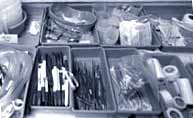 can
collect the items, sanitize them and repackage them for
reuse. Hospitals and medical facilities are also
increasing their use durable linens and laundry services rather than
using disposable gowns and linens.
can
collect the items, sanitize them and repackage them for
reuse. Hospitals and medical facilities are also
increasing their use durable linens and laundry services rather than
using disposable gowns and linens.
| home page |  |
| what's new | |
| defining product stewardship | |
| products/sectors | |
|
|
| contact us | |
